General Handling & Precautions
Proper installation is critical to the lifespan and structural integrity of composite manhole covers. While Fibera FRP covers are engineered for extreme strength, the frame itself is not designed to bear loads independently; it must rely on a fully supported, properly cured concrete foundation. Follow this guide to guarantee a flawless, zero-failure installation.
Before beginning any installation, please adhere to the following safety and handling guidelines to protect the structural integrity of your Fibera FRP products.
Verify Load Capacity
Ensure you are using the correct load capacity cover and frame (e.g., A15 to D400) based on the anticipated vehicle or pedestrian traffic for the specific zone. Refer to our Load Selection Guide prior to installations.
Prevent Impact Damage
Do not drop or throw the Fibera cover or frame while unloading or placing it on the floor. Avoid any heavy impacts from sharp objects on both the cover and the frame during site preparation.
Heat & Fire Safety
Never burn objects on, or near, the manhole cover, grating, or frame.
Component Matching
Exclusively use the supplied Fibera covers with their corresponding, properly sized Fibera FRP frames. Do not mix and match with older cast-iron frames.
Proper Lifting
Always use the dedicated Fibera lifting key supplied with the FRP cover/grating to lift or maneuver it.
Never Leave Open
Never leave an installed frame completely open without its cover or grating safely placed inside.
Step-by-Step Installation Procedure
Follow these crucial steps to correctly seat and bond your Fibera FRP frame.
Step A: Site Preparation
Prepare the concrete bed, meticulously considering the exact height of the Fibera FRP frame so that the final installation sits perfectly flush with the surrounding surface.
Step B: The Concrete Bed
The Fibera FRP frame must be completely embedded in a minimum of M-20 grade concrete. This ensures the foundation is strong enough to transfer heavy traffic loads away from the frame.
Step C: Frame Sizing & Full Support
Check the manhole chamber opening. Ensure that the clear opening of the manhole pit is equal to or slightly less than the clear opening of the Fibera FRP frame. Critical: The resting edge of the frame must be fully supported by the concrete bed; no part of the frame should be left hanging without solid ground support.
Step F: Final Mortar Envelope & Bonding
Use the remaining mortar to fully envelope the Fibera FRP frame, paying particular attention to packing the corner areas tightly. Smooth out the mortar with a trowel to guarantee optimal bonding with the frame and to prevent any initial hairline cracks in the bedding material.General Precautions when using FIBERA FRP Covers and Gratings
- Ensure that you are using the right load capacity cover and frame based on
vehicle/pedestrian movement. Please follow our load selection guide. - Do not drop or throw FIBERA cover or frame while placing it on the floor.
- Avoid impact of sharp and/or heavy objects on the cover and frame.
- Do not burn objects on or near the manhole cover, grating and frame.
- Use only supplied covers with appropriate FIBERA FRP frames.
- Use only FIBERA lifting key supplied with the FRP cover/grating to lift it.
- Occasionally remove the cover from the frame and clean the rim of the
frame of any dirt/dust/pebbles. - Do not leave the frame open without placing a cover or grating.
Installation Steps:
Prepare Bedding
Prepare the concrete bed after considering the height of the Fibera FRP frame.
Concrete Grade
The Fibera FRP frame should be completely embedded in a minimum of M-20 grade concrete.
Clear Opening
Ensure that the manhole clear opening is equal or less than the opening of the Fibera FRP frame. Frame resting should not be hanging without ground support.
Zero-Zero Leveling
Frame should be leveled using a spirit leveler and confirming that the air bubble in the leveler remains exactly at the center (Zero-Zero Level)
Eliminate Gaps
Check gaps under the Fibera FRP Frame. Ensure that there are no visible gaps under the frame and smooth bedding material with a trowel both inside and outside of the chamber.
Final Enveloping
Use the remaining mortar to envelope the Fibera FRP Frame paying particular attention to the corner areas. Smooth out the mortar with a trowel to ensure good bonding with the frame and to avoid any initial cracks in the bedding material.
Visual Guide –
The Right vs. Wrong Way to Install
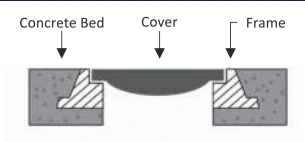
✔️ The Correct Method
(Flush & Supported)
The concrete bed is level, and the entire base of the FRP frame is resting solidly on the M-20 concrete. The top of the cover sits completely flush with the surrounding road/pedestrian surface.
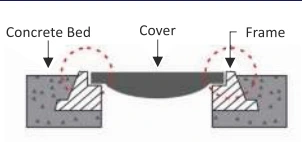
❌ Wrong Method 1 (Unsupported Overhang)
The concrete bed is too wide, causing the inner lip of the FRP frame to hang over the manhole opening with zero support underneath. This will cause the frame to crack under heavy traffic loads.
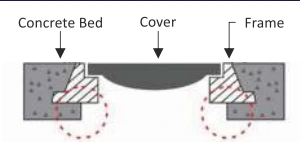
Wrong Method 2 (Uneven / Raised Frame)
The concrete bed is uneven or missing entirely under one side of the frame, causing the frame to sit at an angle or protrude above the road surface. This creates a tripping hazard and subjects the cover to severe impact damage from passing vehicle tires.
Curing Time & Final Handover
Once the frame is perfectly leveled and troweled
Allow Proper Curing:
The frame and mortar must be allowed to set undisturbed for a minimum of 48 hours before subjecting the cover to any vehicular or pedestrian traffic.
Final
Inspection:
Insert the cover carefully into the frame only after the concrete has achieved sufficient grip and compressive strength, and only after brushing away any loose mortar debris from the seating lip.
Curing Time & Final Handover
Once the frame is perfectly leveled and troweled:
➡️ Allow Proper Curing: The frame and mortar must be allowed to set undisturbed for a minimum of 48 hours before subjecting the cover to any vehicular or pedestrian traffic.
➡️ Final Inspection: Insert the cover carefully into the frame only after the concrete has achieved sufficient grip and compressive strength, and only after brushing away any loose mortar debris from
the seating lip.